For allocators

You are always shown the fund that survived.

Somewhere behind every pitch is the research that did not work: the strategies discarded, the windows that flattered, the version before this one. None of it is dishonest — it is simply structurally invisible, because the only place it ever existed was the manager's own machine. So the industry substitutes proxies: pedigree, references, the warm intro, a consultant's six-week opinion, and a backtest Sharpe that predicts out-of-sample results with R² under 0.025 across 888 real algorithms.

A MIZAN credential makes that hidden layer checkable — the trial count, the costs, the window, the failures — without the manager revealing the strategy, and without you trusting us. You re-derive every number yourself, offline, in about 81 milliseconds.

77
Credentials on the
public wall
54
Refusals published —
including our own
~81 ms
To re-verify one
offline, trusting no one
$0
Cost to verify —
forever, for anyone
§ 01Where your process breaks

The funnel is sound. One input isn't.

A desk like yours sees several hundred managers a year, takes a fraction into serious diligence, and allocates to a handful. Investment DD runs two to four months; operational DD one to three more. The process is rigorous almost everywhere — and then it reaches the performance record, and rigour stops, because the record cannot be checked. It can only be re-read.

Top of funnel
200–500
Managers seen per year. Screened on deck, tearsheet, pedigree — nothing checkable.
Serious diligence
15–25
Weeks of a quant analyst's time trying to reproduce results from inputs the manager chose to send.
Cost per candidate
$25–75K
Operational DD alone, outsourced. Before the investment side, the memos, the on-sites.
The uncheckable input
N
How many strategies were tried before this one. Every anti-overfitting correction divides by it. Nobody can verify it.
One mandate placed on an overfit record costs more than every verification you will ever buy. And the industry currently has no mechanism that could have caught it — not audit, not GIPS, not a questionnaire platform. That is the gap this page is about.
§ 02Eight questions, now answerable

Not one of these was ever a question of honesty.

Each was structurally unverifiable: the information existed only on the manager's machine, and asking for it meant asking them to hand over the thing that makes them valuable. Below, each question and the mechanism that answers it — with the manager revealing nothing. Every claim links to the credential that proves it.

01
How many strategies did they try before showing you this one?Self-reported everywhere · uncheckable
The full candidate set is committed before evaluation. N is the leaf count of that commitment, and the winner is forced in-circuit to be the maximum of the committed set. The deflated Sharpe is recomputed against that N — a number the manager cannot shrink afterwards.Committed trial ledger
02
Was the track record built in hindsight?"We've run this since 2021" is a sentence, not a fact
Every credential is timestamped into Bitcoin and RFC-3161 at mint. A chained track must strictly extend a parent whose anchor predates the new bars. To fabricate January in June you would need a January timestamp you do not have.Anchored · append-only
03
Were costs really charged — or is this a gross number in a costless spreadsheet?Rarely disclosed, never binding
The cost model is committed inside the proof and charged before the verdict: fees and slippage per side, printed on the credential. Costs can be raised by the prover, never hidden.Costs charged in-circuit
04
Is this out-of-sample, or a curve fitted until history behaved?The tuned curve is all you are shown
Walk-forward out-of-sample, the probability of backtest overfitting across all 12,870 balanced partitions, and purged, embargoed cross-validation — computed inside the circuit, on committed data, by a gate the prover cannot tune.PBO · CPCV · in-circuit
05
Did they choose the window that flatters them?Inception date is a choice
The evaluation window is pinned to a canonical, provenance-fixed dataset whose Merkle root the verifier checks against its own copy. The manager submits a strategy, not a chart.Data root pinned
06
Is this real skill, or expensive market beta?The most common quiet answer
Independence is proven in-circuit — one minus joint R² against market, momentum and reversal. When we ran the S&P 500 itself through the gate it printed independence 0%: 99% market beta, and the proof says so.Independence proven
07
What did they fail at, before this?The graveyard is never in the deck
The registry is append-only and refusals are published — including ours. Apple buy-and-hold at +272,548%: refused. Our own AI at +895%: refused. Our own flagship: not significant, published anyway. Failures cannot quietly stop existing.Public refusal record
08
And can you have all of the above without them handing you their edge?The reason they always said no
Yes — that is the whole point. The strategy is never revealed: not to you, not to us, not to anyone. A zero-knowledge proof lets the numbers be checked while the method stays sealed. It is why a manager will agree to be examined at all.Zero-knowledge · the mechanism
And you check it, not us. A credential is not a letter of opinion from a verifier you must trust. It is a 225 KB artifact that re-derives every asserted property on your own machine, offline, against your own copy of the data — trusting no one, including MIZAN. If we vanished tomorrow, every credential ever issued would still verify.
§ 03The part nobody sells you

The manager you actually want has no pedigree yet.

Every desk knows this and almost none can act on it. The returns that make a career come from backing someone before the consultants, before the third-party marketer, before the name is safe. But an unknown with a real edge and a famous name with a fitted one look identical on paper — so capital routes to the pedigree, because pedigree is the only thing that has ever been checkable.

That is not caution. It is a measurement failure, and it has a price: the allocations you were right about and could not defend, and the ones you defended and were wrong about.

When honesty itself becomes checkable, the two stop looking alike. A first-time manager with a committed trial ledger, a pinned data root and a published refusal record is now more examinable than a twenty-year name whose record is a PDF. You are no longer choosing between conviction and defensibility. You can be early and still be able to show your work.

This is the only claim on this page that is about upside rather than risk, and it is the one we would defend hardest: a verification layer does not simply stop you making a bad allocation. It lets you make the good one sooner than the people who need a track record to be famous before they will believe it.

§ 04What showing your work looks like

One page. Nothing on it taken on trust.

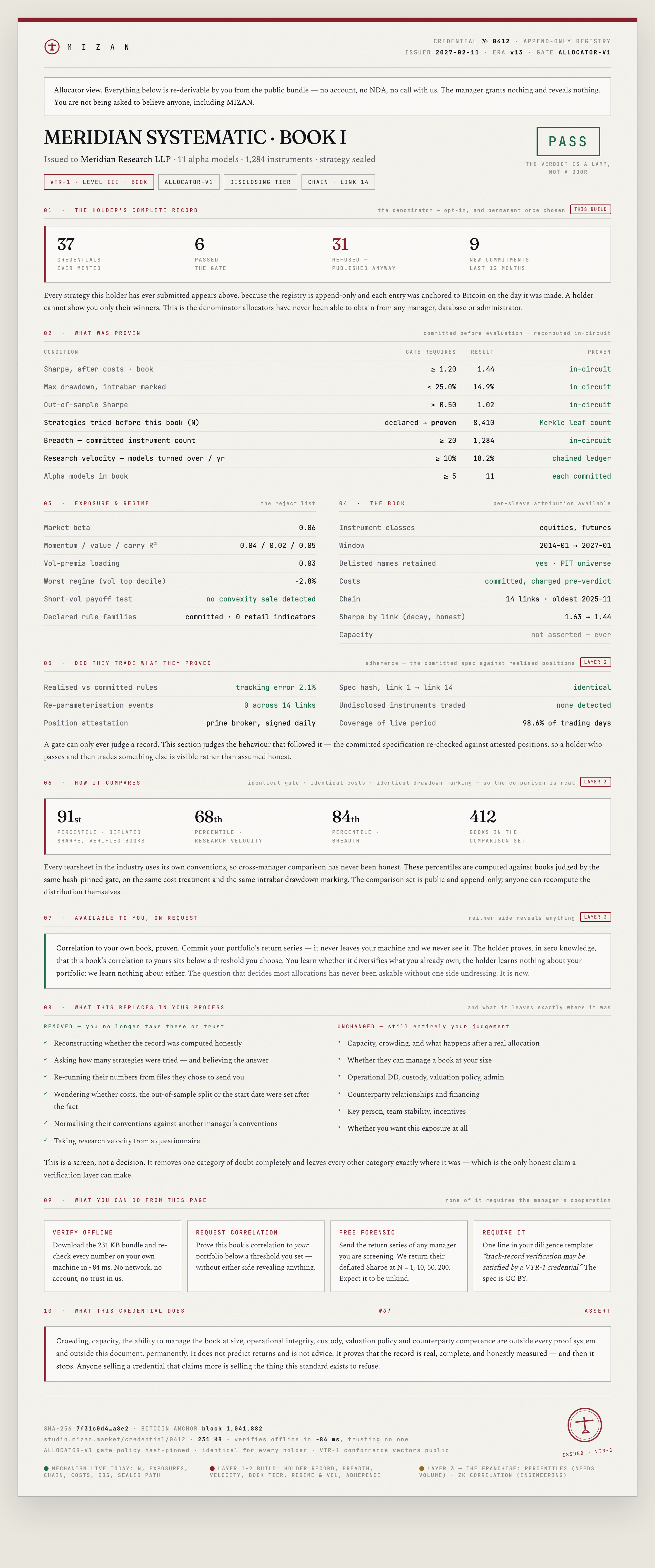
This is a book-level credential as it reads when a manager submits an entire programme rather than a single signal. The denominator at the top is the part no database, administrator or manager has ever been able to give you: every strategy this holder has put in front of the gate, passes and refusals together. Below it, the gate ladder with the thresholds beside the results, the exposure panel that answers a rejection list, and — printed as loudly as the rest — the questions it refuses to answer.

SPECIMEN · NOT ISSUED
ALLOCATOR-V1 specimen credential — fictional holder; several fields are not yet issuable

A specimen, and labelled as one. The holder is fictional and several fields are not issuable today — the legend printed at its foot marks every field as live now, pending a published engine era, or gated on the world. No credential on the public registry carries an unproven field, and none ever will. A specimen lives on a specification page and nowhere near a credential URL. The full field-by-field status: ALLOCATOR-V1 →

§ 05Do it now, on a manager you are actually screening

Don't take this page's word either.

Two of these run in your browser, on your own numbers, with nothing sent to us.

Kill a Sharpe yourself. Enter a manager's Sharpe, sample length and a plausible number of trials, and watch the deflated figure fall as the search grows — the arithmetic every screen skips. Open the calculator →
Watch it run on nine famous records. Celebrated strategies, one pre-registered configuration, verdicts published either way. See the survival analysis →
Re-verify a real credential offline. A 225 KB bundle, your own copy of the data, no network and no account. Verify it yourself →
§ 06The arithmetic of the ticket

You already pay for verification that stops before the number.

What a desk pays for todayPriceCan it check the trial count?
Operational due-diligence review$25–75K / fundNo
GIPS verification$10–50K / yrNo — it verifies the process, not the mathematics
Performance examination$50K / strategyNo
Questionnaire platform subscriptionup to $100K / yrNo — it circulates the manager's own answer
MIZAN credential$6K / yrYes — N is a committed Merkle leaf count

Verification is free forever — for you, for any platform, at any scale. The fee sits on issuance, never on checking. And while open testing lasts, minting is free too.

§ 07Built from an allocator's own screen

The requirements, in his words.

In August 2026 a partner-level allocator at a top-tier global institution wrote to us, unprompted and at length, explaining exactly how his desk screens managers — and why cryptographic verification of a single alpha signal moves very little needle for him. It is the most useful message this company has received. His criteria became a gate class.

One line in it changed the product. He wrote that 10–20% of alpha models should turn over each year for a quant strategy to stay sustainable — and that judging sustainability is the hard part of his job. That number is self-reported in every due-diligence questionnaire in the industry. A chained, append-only ledger measures it structurally: each model committed and timestamped as it is created, retirements visible, the cadence anchored to Bitcoin so no history can be added later. We know of no other way to prove research velocity, and we did not see it until he wrote it down.

Eleven criteria, the credential field that answers each, and what it honestly costs to build — including three that no proof system will ever answer, marked as permanent refusals rather than roadmap. ALLOCATOR-V1 → the specification, and the credential it issues

§ 08Where it already earns its place

Three moments where the record's honesty is the whole gamble.

The spin-out. A PM leaves a pod with a backtest and eighteen months of paper. No audited history exists yet, so the honesty of the record is the decision.
The new-sleeve pitch. An existing manager you already trust proposes a new programme. That simulation is self-reported backtest land, sitting inside a relationship you have already underwritten.
The inbound long tail. Hundreds of decks a year, screened on polish and pedigree because there is nothing else to screen on. A forensic in a day, or an existing credential in 81 ms.
§ 09The limit, stated plainly

What this still cannot tell you.

The list above is exhaustive about the past and silent about the future — deliberately. A credential does not certify future returns, capacity, market impact, crowding, operational risk, custody, counterparty exposure, or whether a manager will actually trade what they proved. It cannot detect fraud that lives outside the strategy. A passing credential is not advice, not a recommendation, and not a substitute for your own diligence. It removes one category of doubt completely and leaves every other category exactly where it was. Anyone claiming more than that is selling you the thing we exist to refuse.
§ 10For circulating inside your team

Seven questions — written to be forwarded.

A note to put in front of any manager pitching any track record, in any asset class. None of the seven depend on MIZAN existing. For each: why it matters, what an honest answer sounds like, and the tell when someone retreats into vocabulary. It opens by disclosing that we run a verification company and therefore have an interest in these questions being asked — judge it by the questions, not by us.

§ 11How the forensic works

Four steps. The manager never has to know.

Step 01
You send a return series
Monthly or daily returns for a manager you are screening. No name required, no strategy, no positions. Their identity is irrelevant to the mathematics.
Step 02
We run the survival analysis
Deflated Sharpe at N = 1, 10, 50 and 200 trials, with every assumption printed on the page so you can change any of them.
Step 03
You get the result — either way
Usually within a day. If the record survives, you have something you could not otherwise obtain. If it dies, you saved an allocation. Expect it to be unkind.
Step 04
You keep it. We publish nothing
The result is yours. We do not name the manager, list them, or write about it. Nothing enters the public registry without the holder's own election.
What we never see: the manager's strategy, their positions, their code, your portfolio, or your allocation decision. What it costs: nothing — no account, no contract, no procurement.
§ 12The loop, end to end

Prove it. Verify it. Allocate against it.

Three verbs, three parties, and a clean wall between each. MIZAN performs exactly one of them, and never touches a dollar.

Prove
the quant
A strategy is examined under the locked gate and minted as a credential — the trial count committed, the strategy never revealed. On the studio →
Verify
you
You re-derive every number on your own machine in ~81 ms — no account, no NDA, no trust in the manager or in us. Run it yourself →
Allocate
through licensed partners
Capital flows to what passed — on a platform's or seeder's own licensed rails. Never through MIZAN. The venues →
The third verb is the one we refuse to perform. We prove and we publish; the allocating happens on someone else's rails, under someone else's licence — which is exactly why the credential in the middle can be trusted by both sides. A referee that also took the bets would be no referee at all.
§ 13The first step

Test it on a manager you are screening this quarter.

Pick one live candidate. Send the return series. You keep the result whichever way it falls, and the manager is never involved. If it changes nothing about how you see that record, we will have cost you one email — and we would rather learn that from you than guess.

ENGINE v11 · 3ac3b10b… ● LIVE REGISTRY 77 CREDENTIALS · APPEND-ONLY VERIFY ~81 MS · OFFLINE · TRUSTING NO ONE ANCHOR BITCOIN #962,013 SPEC VTR-1 · FROZEN · CC BY ROOT 88298a2e…c6825a · MERKLE-COMMITTED